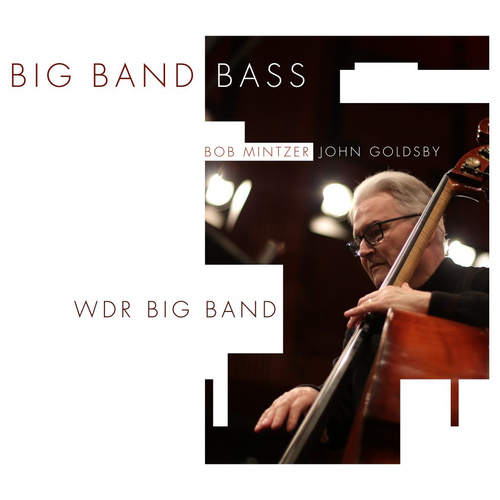
Conducted by Bob Mintzer
Saxophones: Karolina Strassmeyer, Johan Hörlén, Paul Heller, Ben Fitzpatrick, Jens Neufang
Trumpets: Bastian Stein, Andy Haderer, Rob Bruynen, Wim Both, Ruud Breuls
Trombones: Ludwig Nuss, Jonathan Böbel, Philipp Hayduk, Mattis Cederberg
Rhythm Section: Billy Test (piano), Hans Dekker (drum set), John Goldsby (double bass)
Arnd Richter - Manager WDR Big Band
Christian Schmitt - Tonmeister, Recording Producer
Walter Platte - Toningenieur
1 Sonatinita
2 In The Hills
3 Blue Balloon
4 Kléopatre's Secret
5 You Can Call Him Maestro
6 Dahlia Garden
7 The Baron's Dilemma
8 Sergio
In a landmark moment for one of Europe’s most celebrated large ensembles, Big Band Bass—out November 7, 2025 on Bass Lion Publishing—sees American bassist John Goldsby step into the spotlight as composer and featured soloist with the Grammy winning WDR Big Band. Marking his 30th anniversary as a member of the Cologne-based group, the album showcases eight original compositions arranged by long-time collaborators Bob Mintzer, Michael Abene, Dave Horler, and Vince Mendoza.
Liner Notes:
Martin Johnson, Jazz Critic for NPR Fresh Air, the Wall Street Journal and Downbeat
The lineage of bass players in the 21 st Century who have taken the helm of a big band is a short list of all-time greats: Ron Carter, Dave Holland, and Rufus Reid to name just three. It takes ambition and creative fortitude to join the lineage, but John Goldsby accomplishes just that on his album Big Band Bass, a recording that celebrates his 30 years with the WDR Big Band with arrangements by the legendary Bob Mintzer.
Goldsby, a Louisville native who established himself on the rugged New York City jazz scene of the ‘80s and ‘90s before relocating to Germany, has a classic tone. His bass sound recalls the early cornerstones of the instrument like Jimmie Blanton and Oscar Pettiford, and he applies it to a delightful mélange of music, showcasing a diverse range of contemporary orchestral jazz.
The recording leads with that diversity on “Sonatinita,” a Vince Mendoza composition and arrangement that deftly features Goldsby’s fluid style contrasted by a lovely chorus of woodwinds before shifting into a resplendent full band segment highlighted by a solo from trombonist Ludwig Nuss, and a closing with a slight recasting of the beginning featuring the leader and woodwinds. Goldsby’s “In the Hills,” arranged by Dave Holder, former lead trombonist in the band, also features Nuss and the leader, but this time against the backdrop of boisterous exuberance from the horn sections, providing remarkable contrasts and excitement.
Goldsby’s “Blue Balloon” (yes it was inspired by the sight of a hot air balloon in Baden Baden) is reminiscent of classic Blue Note 60s hard bop, and it features rousing solos by trumpeter Ruud Breuls, alto saxophonist Johan Hörlén, and tenor saxophonist Paul Heller, who elevate the composition to a contemporary urgency.
“Kléopatre’s Secret” also takes its inspiration from a renowned resident of Baden Baden, the white Burmese cat that patrols the Brenners Park Hotel. The piece is alternately pensive and strident, featuring pianist Billy Test, alto saxophonist Karolina Strassmayer, and flugelhornist Bastian Stein. Mintzer’s arrangement brings out the wide-ranging feline moods.
The leader takes charge again on “You Can Call Him Maestro,” a meditation on both the reverence in which the term is properly used and ribald snark over the way in which it is often casually assigned. Goldsby’s stellar solo is followed by similar power from trombonist Jonathan Böbel.
A sumptuous ballad,“Dahlia Gardens,” is also inspired by a setting in Baden Baden, the Lichtenthaler Allee. Mintzer’s arrangements recall Ellingtonian style, especially the baritone sax solo by Jens Neufang, so reminiscent of Harry Carney’s signature work with the Duke. Goldsby captures the stately elements of the setting without becoming stuffy. The music’s elegance is stunning.
No big band recording is complete without an uptempo burner, and on “Baron’s Dilemma,” three tenor saxophonists, Ben Fitzpatrick, Paul Heller, and Mintzer, offer contrasting and intertwined commentary on the presumed hectic life on a Baron, and inherited title that is no longer officially recognized but carries social weight and obligation.
The Brazilian influence heard in “Sergio” may bring to mind the classic composer and bandleader Sergio Mendes, but it’s actually dedicated to a tour guide Goldsby met on a trip to Salvador, Bahia. Samba rhythms underpin a complex weave of instruments highlighting both the drama and splendor in Brazil.
During Goldsby’s time with the WDR, big band music in jazz grew in stature and recognition. Rather than being a relic of an earlier era, orchestral jazz is now again recognized as a vital, contemporary part of jazz. Composers and bandleaders from every corner of the genre are assembling large groups that push the envelope. Some draw on classic influences like Woody Herman, Quincy Jones, Count Basie, Duke Ellington, Thad Jones-Mel Lewis, Gil Evans and Maria Schneider; others are bringing new concepts into the fold.
With this valedictory statement, Goldsby illustrates the power and savvy that one virtuoso player can make among many and how the orchestra can rise to highlight that player. Big Band Bass does what great jazz does; it celebrates a glorious past and projects a promising future.